Executive Summary
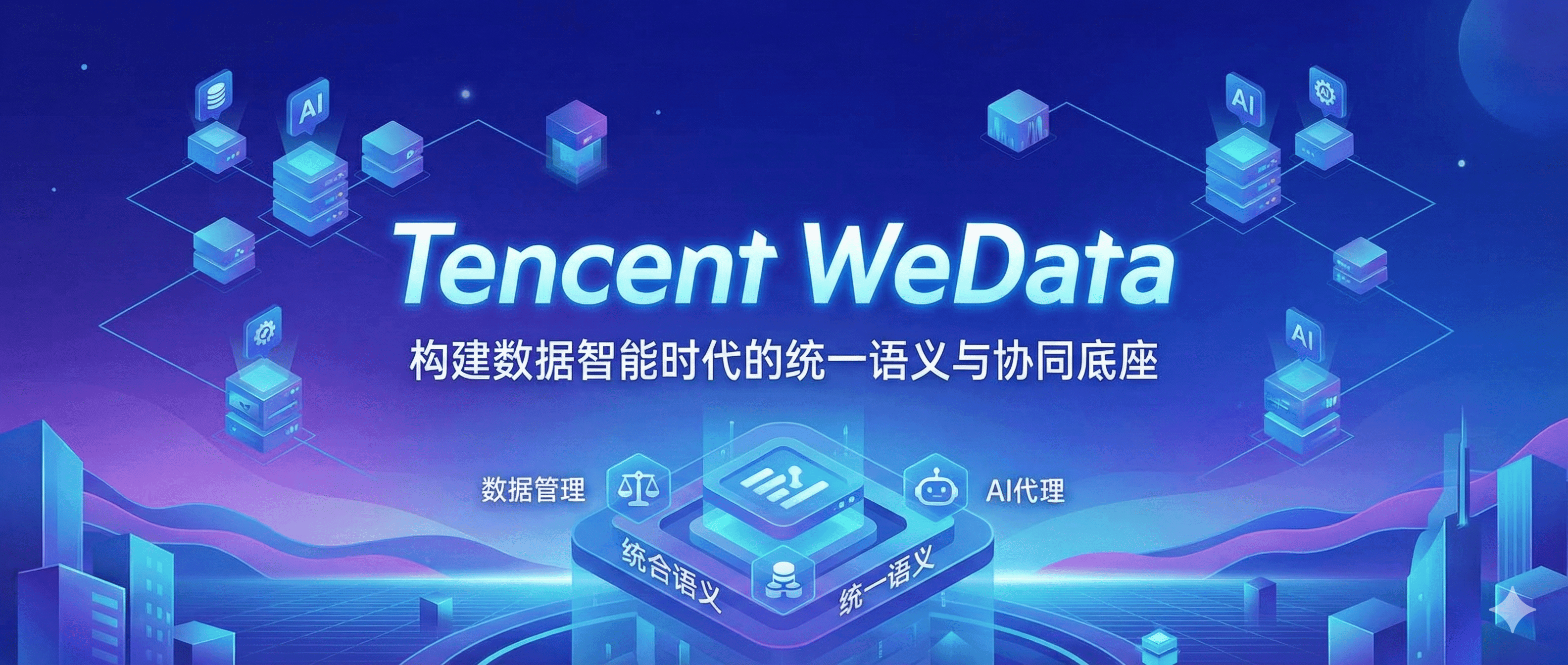
Tencent Cloud WeData is positioned as a data foundation for enterprise AI agents. Its value is not only in data integration, but in creating a governed semantic layer that lets business users, analytics systems, and AI applications speak the same language.
For companies experimenting with AI agents, this matters because the bottleneck is rarely the model alone. The harder problem is whether the model can access trusted data, understand business definitions, and avoid generating confident but incorrect answers.
Why Enterprise AI Needs a Semantic Layer
Most enterprise data environments are fragmented. Sales, membership, finance, operations, and marketing teams often define the same metric differently. A large language model connected directly to this environment can retrieve data, but it may not understand which definition is authoritative.
WeData's unified semantic approach is intended to solve that problem. By centralizing metric definitions, business entities, data lineage, permissions, and query logic, it creates a reliable interpretation layer between raw data and AI applications.
From Data Governance to Agent Execution
Traditional data platforms focus on storage, pipelines, and dashboards. AI-agent scenarios require an additional step: the system must convert natural-language intent into safe, explainable, and permission-aware actions.
That means the platform needs:
- governed data catalogs
- consistent business metrics
- role-based access control
- metadata and lineage
- query generation that business teams can verify
- retrieval pipelines for unstructured and structured knowledge
In this architecture, WeData becomes a coordination layer. It helps the AI agent understand not only where the data lives, but what it means and whether it can be used.
SemQL, MCP, and RAG
The emerging enterprise AI stack includes three important ideas.
SemQL provides a semantic query layer. Instead of forcing users to know database schemas, it lets the system map business questions to governed metric definitions.
Model Context Protocol (MCP) provides a standardized way for models and tools to exchange context. When connected carefully, it can help AI systems access enterprise tools without one-off integrations for every use case.
RAG, or retrieval-augmented generation, gives the model relevant context before it answers. In enterprise settings, that context should come from governed sources, not random documents or stale exports.
Together, these ideas reduce hallucination risk and make AI outputs easier to audit.
Business Value
The immediate value is better decision support. A sales manager can ask why conversion dropped in a region and receive an answer grounded in governed metrics. A marketing team can compare campaign cohorts without waiting for a custom dashboard. An operations team can investigate supply-chain exceptions with traceable data.
The deeper value is organizational consistency. When definitions are unified, teams stop debating which number is correct and start discussing what action to take.
Implementation Recommendations
Enterprises should avoid starting with a broad "AI everything" program. A more reliable path is to pick one business domain, define the core metrics, clean the data lineage, and build a limited agent workflow around real operational decisions.
Recommended first steps:
- select one high-value business scenario
- define authoritative metrics and ownership
- connect only necessary data sources
- test permissions and audit logs early
- review model answers with business users before broad rollout
AI agents become useful when they are grounded in trusted business context. WeData's role is to provide that context in a way that can scale across teams.