

Depth Anything 3 (DA3), released by ByteDance's Seed team, is an important development in computer vision and 3D spatial reconstruction. It uses a single Transformer architecture to support depth estimation, camera pose understanding, and multi-view reconstruction in a simpler and more unified way.
For enterprise teams, the lesson is not only technical. DA3 shows how a simpler architecture can reduce deployment complexity while improving practical performance.
 Depth Anything 3 technical demo
Why 3D Reconstruction Is Hard
Machines need to infer 3D structure from 2D images for autonomous driving, robotics, AR/VR, mapping, retail visualization, and digital twins. Traditional approaches often combine several specialized modules for depth, camera pose, feature matching, and geometry reconstruction.
That creates complexity. More modules mean more interfaces, more training difficulty, higher compute requirements, and harder deployment.
The Architecture Shift
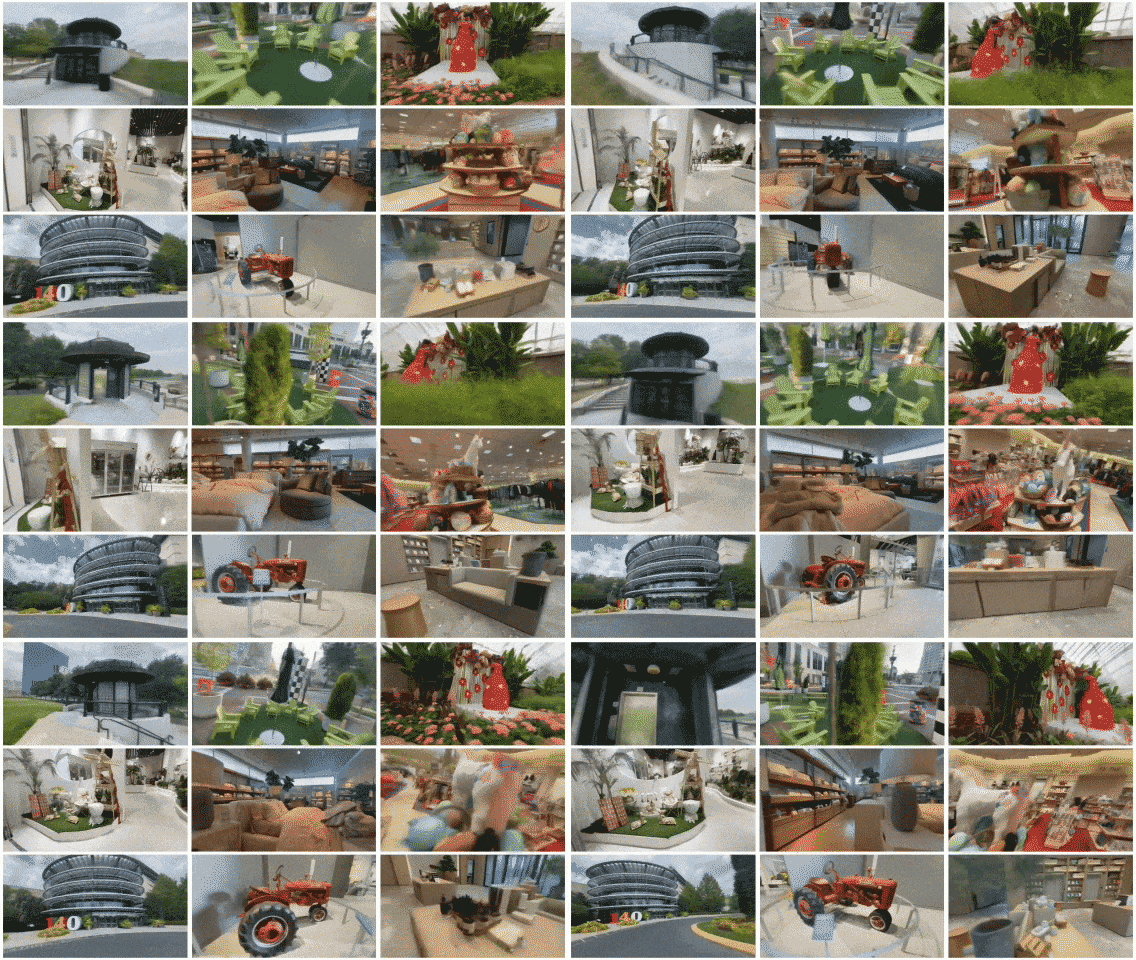 Technical architecture diagram
DA3 takes a more unified approach. A single Transformer can model long-range dependencies and exchange information across views without requiring a separate custom module for every task.
The model also uses a depth-ray representation. Depth tells the distance from a pixel to the camera, while the ray describes the projection direction into 3D space. Together they provide a compact description of spatial geometry.
Compared with point-cloud-first representations, this approach separates geometry from camera motion more naturally and can simplify downstream reconstruction.
Performance and Practical Value
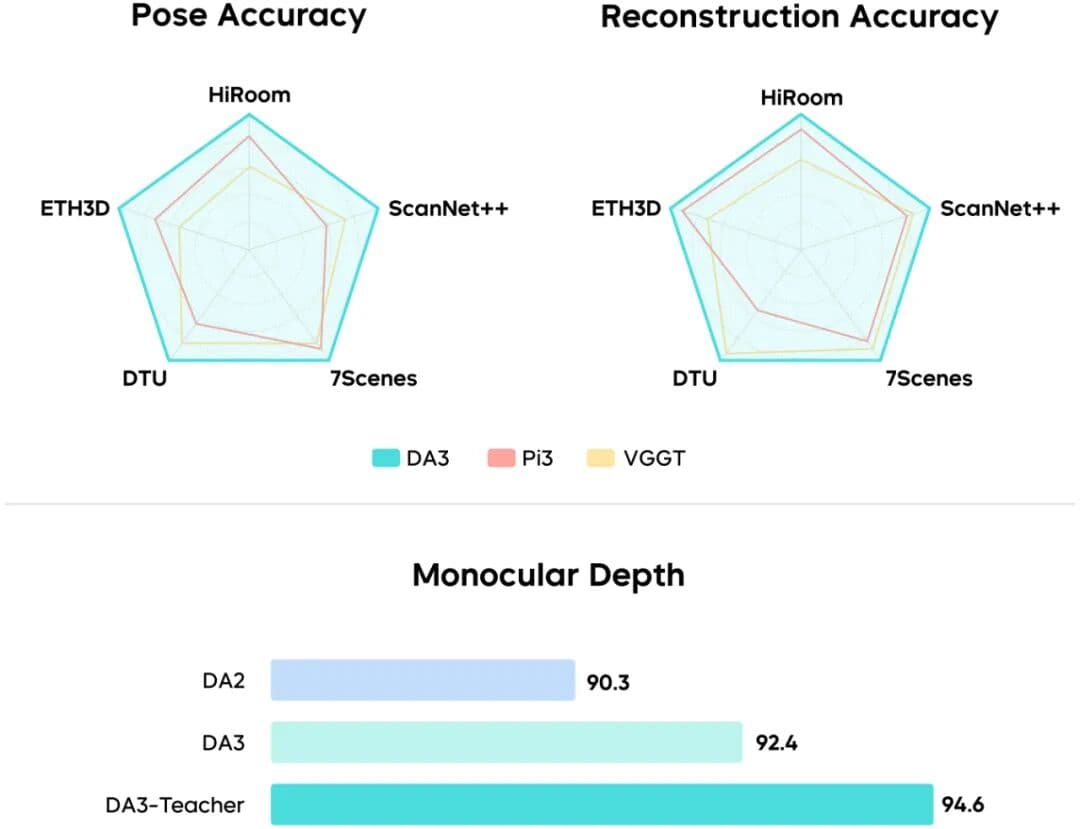 Depth Anything 3 reconstruction example
DA3's reported results show improvements in camera pose estimation and geometry reconstruction compared with earlier mainstream approaches. The bigger business point is that better accuracy comes with a cleaner architecture.
That can matter in scenarios where teams need to deploy models across devices, integrate with existing perception systems, or reduce the cost of maintaining several specialized pipelines.
Business Applications
 IT consulting collaboration
Potential applications include:
- autonomous driving perception
- robotics navigation
- virtual product displays
- retail 3D visualization
- property walkthroughs
- digital twins for factories or campuses
- AR/VR scene reconstruction
For retailers, better 3D reconstruction can support richer product experiences. For real estate, it can improve virtual viewing. For manufacturers, it can support inspection and spatial analysis.
Implementation Advice
Companies should not adopt DA3 simply because it is new. Start with a clear use case, define accuracy and latency requirements, and test against real image conditions.
A practical pilot should include:
- representative image or video data
- quality benchmarks
- deployment-cost estimates
- integration planning
- privacy and security review
- human evaluation of outputs
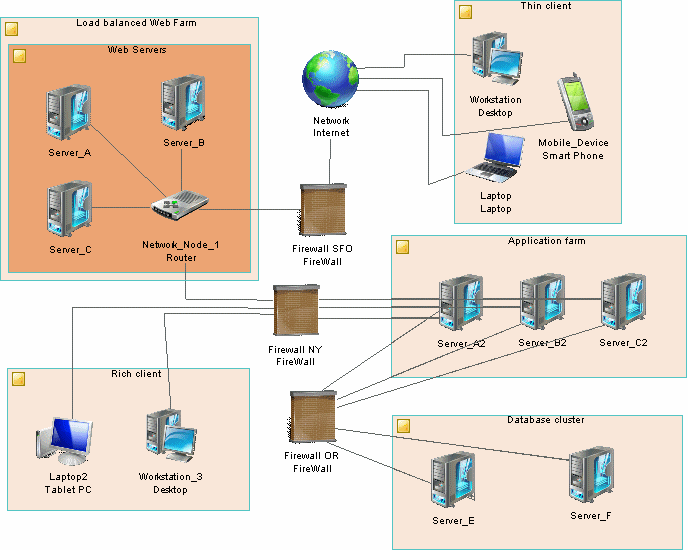 Technical infrastructure
Strategic Takeaway
DA3 points toward a broader enterprise architecture principle: unified systems often outperform fragmented stacks when the underlying problem can be modeled cleanly.
For digital transformation teams, this is a useful reminder. Complexity is not the same as capability. The strongest technical systems are often those that express the core problem simply and scale from there.